
La Geria: From Timanfaya’s Ashes to Lanzarote’s Wines
19 November 2026 · Lanzarote Experience Tours Team
Discover how the Timanfaya eruptions transformed La Geria and how Lanzarote’s farmers created its remarkable volcanic vineyards. A story of survival, ingenuity, tradition and wine.
The extraordinary story of how Lanzarote’s farmers transformed the aftermath of a volcanic catastrophe into one of the most remarkable wine-growing landscapes in the world.
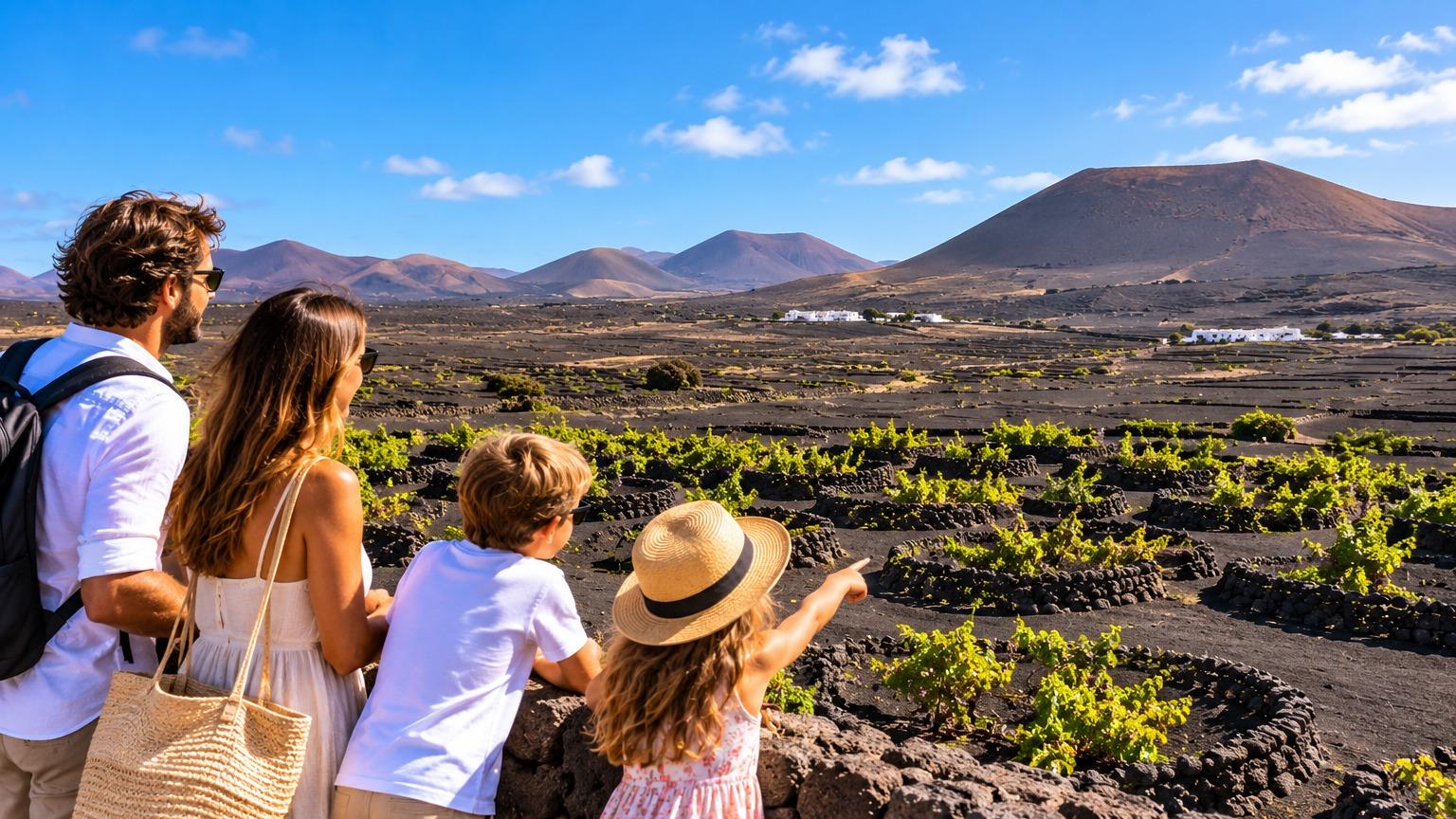
Anyone visiting La Geria for the first time discovers a landscape that is difficult to forget. Thousands of pits dug into black volcanic soil, small grapevines protected by semicircular stone walls, and mountains that reveal the volcanic origins of this extraordinary region.

At first glance, the landscape might appear to have been carefully designed. Yet its origins are far more surprising. La Geria was not created as a wine-growing project. It was born out of the need to survive. To understand how these remarkable vineyards came into existence, we must travel almost three centuries into the past, to a very different Lanzarote, where agriculture, livestock farming and the careful use of natural resources shaped everyday life.
Before Timanfaya: When Lanzarote Was a Land of Cereals
Long before wine became one of Lanzarote’s most recognised products, the island had a deeply agricultural economy. Lanzarote and Fuerteventura historically played an important role in supplying cereals to the Canary Islands, particularly wheat and barley. Both islands were therefore regarded as part of the archipelago’s traditional grain-producing region. The fields we see today covered in volcanic ash once included cultivated land, grazing areas, roads and small settlements. Cereals were among the population’s most important food resources. Some of the grain was roasted and ground to produce gofio, a traditional Canarian flour that formed an essential part of the local diet. The straw remaining after the harvest was used to feed livestock, prepare animal bedding and even fill mattresses in family homes. In that rural society, almost nothing was wasted.
A Family Economy Based on Self-Sufficiency

For generations, many families lived primarily on what they could produce themselves.They grew cereals, legumes, vegetables and fruit trees adapted to the island’s conditions. Near their homes, fig trees, prickly pear cacti and grapevines provided fruit that could be eaten fresh or preserved by drying. Dried figs, raisins and other stored foods helped families survive periods when harvests were scarce. Animals also played an essential role.

Chickens provided eggs, goats supplied milk for making cheese, and pigs represented an important food reserve for some households. Camels, donkeys and mules helped with agricultural work and the transportation of crops, materials and goods. It was an economy based on hard work, careful use of resources and the need to provide food for the family.
Water: Lanzarote’s Most Precious Resource
Water scarcity has profoundly shaped Lanzarote’s history. The island has no permanent rivers, and rainfall is limited and irregular. For centuries, families collected rainwater and stored it in underground cisterns, reservoirs and traditional water-storage structures known as aljibes and maretas. These reserves had to last until the next rainfall, which could take months to arrive. During severe droughts, water shortages became so serious that ships had to bring supplies from other Canary Islands. This explains why Lanzarote’s farmers developed ingenious techniques to make the most of even the smallest amount of moisture. And then, in 1730, everything changed.
1730–1736: The Eruptions That Transformed Lanzarote

On 1 September 1730, one of the most significant volcanic episodes in the history of the Canary Islands began. For almost six years, the Timanfaya eruptions transformed extensive areas of southwestern Lanzarote. Lava flows destroyed villages, roads and farmland. Elsewhere, enormous quantities of volcanic ash, locally known as picón or rofe, covered fertile agricultural land. La Geria was one of the areas profoundly affected. For farmers, losing their land meant far more than losing property: it meant losing their principal means of survival. Yet beneath the black volcanic material, fertile soil remained buried in many places. The farmers began searching for ways to recover it.
The Bishop and the Recovery of Agricultural Land
One of the stories associated with the agricultural transformation of La Geria involves Pedro Manuel Dávila y Cárdenas, Bishop of the Canary Islands, who visited Lanzarote in 1733 while the eruptions were still continuing. Local tradition attributes to him a role in encouraging efforts to recover farmland covered by volcanic ash. It is easy to imagine the enormous difficulty of removing these layers of ash using only hand tools and pack animals. Historical documentation, however, introduces an important distinction: before the bishop’s visit, inhabitants of Yuco and Tinguatón had already begun experimenting with the agricultural possibilities of the newly formed volcanic terrain. Farmers gradually discovered that the black volcanic material, initially regarded as a disaster, also possessed remarkable moisture-conserving properties. The agricultural recovery of La Geria was therefore the result of observation, hard work and adaptation by the island’s inhabitants. Even today, place names such as Barranco del Obispo, where Bodega Stratvs is located, invite curiosity about the region’s history. However, a direct documentary connection between this place name and the origins of pit cultivation has not been established.
The Birth of La Geria’s Vineyards

The solution developed by Lanzarote’s farmers was simple in principle but extraordinary in practice. They began digging deep pits through the layers of volcanic ash until they reached the fertile soil beneath. Grapevines were planted at the bottom, allowing their roots to develop in the original soil. Grapevines had already been cultivated in Lanzarote before the eruptions, but their importance increased considerably in La Geria during the following decades. This was the beginning of the landscape we recognise today: individual pits excavated by hand, small grapevines and semicircular walls built from volcanic stone.
Why Are the Pits So Deep?
According to the Regulatory Council of the Lanzarote Designation of Origin, the layer of volcanic lapilli or picón can reach a thickness of up to three metres in some areas of La Geria. Farmers therefore had to dig until they reached the fertile soil. The distance between individual vines can reach four metres, considerably more than in conventional vineyards. This planting arrangement helps explain why traditional cultivation in La Geria requires so much land and manual labour.
The Secret of Picón: Preserving Moisture Without Irrigation
Traditional agriculture in La Geria is based on dry farming. This means that grapevines depend primarily on rainfall and on the moisture retained in the soil. The volcanic lapilli plays an essential role. Its structure allows rainwater to infiltrate the soil, reduces evaporation and helps preserve moisture for extended periods. It also helps limit surface runoff and soil erosion. Night-time dew and atmospheric humidity may provide additional moisture, although their actual contribution depends on climatic conditions.
Thanks to this system, farmers managed to establish vineyards in an environment characterised by very limited rainfall. The technique proved so effective that it was later adapted elsewhere in Lanzarote through the creation of artificial volcanic mulches, known as arenados artificiales, where a thinner layer of picón protects crops such as vegetables.
Not All Lanzarote Vineyards Are the Same
Although La Geria’s deep pits are the island’s best-known wine-growing landscape, other traditional cultivation systems also exist. In areas such as Tinajo and Haría, farmers use trenches adapted to local terrain and to thinner layers of volcanic lapilli. These differences reflect the ability of Lanzarote’s farmers to adapt their techniques to the particular conditions of each location. In every case, the objective is similar: to make the most of available moisture, protect the plants and maintain agricultural production in a demanding environment.
Trade Winds and Volcanic Stone Walls

Water was not the only challenge. Lanzarote is exposed to the trade winds, which are particularly frequent during late spring and summer. The prevailing winds generally come from the north and northeast and can affect young shoots, leaves and grape clusters. To protect the vines, farmers built small semicircular volcanic stone walls known locally as zocos. These walls face the prevailing winds and create a sheltered space around each plant. Viewed from the surrounding hills, the repeated pattern of pits and crescent-shaped walls creates an unmistakable landscape. Yet their beauty is the result of a practical purpose. Every zoco represents an agricultural solution passed down through generations.
The Grape Harvest: A Tradition Still Carried Out by Hand

Lanzarote has one of the earliest grape harvests in Europe. In many years, harvesting begins in July, although the exact dates vary according to the season, grape variety and ripening conditions. Unlike other wine-producing regions where large mechanical harvesters are used, grapes in La Geria’s traditional vineyards continue to be picked by hand. Workers must enter each pit, carefully cut the grape clusters and carry them out. The slopes, depth of the pits and individual arrangement of the vines make mechanisation extremely difficult. The Regulatory Council of the Lanzarote Designation of Origin confirms that the traditional harvest is carried out without mechanisation.
How Many Grapes Does a Vine Produce?
Production depends on numerous factors, including the age of the vine, rainfall, vineyard conditions and the characteristics of each harvest. The Regulatory Council establishes a maximum authorised yield of 7,000 kilograms per hectare, although this figure does not necessarily represent actual production. In La Geria’s traditional vineyards, where plants are widely spaced and growing conditions are demanding, yields can be considerably lower. According to the Regulatory Council, the average age of the vines is generally between 30 and 50 years, although much older vineyards and more recent plantations also exist.
When Camels Transported the Grape Harvest

Before modern vehicles arrived, camels played a fundamental role in Lanzarote’s agriculture. They helped plough fields, transport materials, carry harvests and move goods along the island’s rural tracks. During the grape harvest, they also carried grapes from the vineyards to wine presses and wineries. Their endurance and carrying capacity made them especially valuable working animals. Historical photographs preserved in archives such as Memoria de Lanzarote help us remember a time when the grape harvest was deeply connected to traditional rural life.
From the Family Wine Press to the Winery

For generations, part of Lanzarote’s wine production was made using traditional methods. Farmers who owned vineyards and had suitable facilities brought their grapes to a wine press, or lagar, where they were trodden to extract the must. Fermentation then began, transforming the natural sugars in the grapes into alcohol. The wine was stored in containers, casks and barrels, and could be intended for family consumption, exchange or sale. Traditional taverns and village shops also played an important role in social life. Neighbours, traditionally mainly men, gathered there to talk, exchange news and enjoy a glass of wine. These homemade wines could be intense and relatively high in alcohol, although their characteristics varied according to the grape varieties and production methods used. Over time, commercial wine production became increasingly important. One of the best-known historical examples is Bodegas El Grifo, founded in 1775, which preserves an important heritage associated with winemaking.
Phylloxera: The Pest That Transformed European Vineyards

During the second half of the nineteenth century, a tiny pest originating in America profoundly transformed European viticulture. It was phylloxera, an insect capable of attacking grapevine roots and causing severe damage, eventually killing affected plants.
The pest reached Europe through the trade in American plant material and began spreading through important French wine-growing regions before reaching other countries. To restore their devastated vineyards, European growers began grafting traditional grape varieties onto rootstocks from American vine species resistant to phylloxera. Historically, the Canary Islands remained outside the widespread devastation experienced in continental Europe, allowing the preservation of particularly valuable viticultural heritage.
Ungrafted Vines: Original Roots
Traditional vineyards with ungrafted vines, also known as own-rooted vines or pie franco, can still be found in Lanzarote. This means that the cultivated grape variety grows on its own roots rather than being grafted onto a different rootstock. It is a characteristic of considerable historical and viticultural interest. The wine-growing tradition of La Geria dates back to the expansion of vineyards during the eighteenth century, although not every vine growing today is necessarily that old. It is important to note that phylloxera was detected in Tenerife for the first time in 2025, making the continued phytosanitary protection of the Canary Islands’ vineyards particularly important.
Malvasía Volcánica: The Soul of Lanzarote’s Wines

If one grape variety is especially associated with Lanzarote’s wine-growing identity, it is Malvasía Volcánica. It is a distinctive variety closely connected to the island’s agricultural history. Its wines can display floral and fruity aromas, freshness and a character influenced by the soil, the conditions of each vintage and the winemaking process. Although many people associate Malvasía with sweet wines, it is also used to produce dry white wines. Malvasía Volcánica is central to much of Lanzarote’s wine production, but it is not the only variety grown on the island. Other varieties include Listán Blanco, Diego or Vijariego, Moscatel and, among the red varieties, Listán Negro.
Lanzarote’s Wines Today
Lanzarote’s wine production offers a diversity that many visitors are unaware of. Dry white wines are generally appreciated for their freshness and aromatic expression. Off-dry and medium-sweet wines offer different balances of sugar and acidity. Sweet wines, made from varieties such as Malvasía and Moscatel, may present notes of ripe fruit, honey or raisins. Rosé and red wines, particularly those made from Listán Negro, broaden the island’s range of wines. There are also sparkling wines, including Brut styles, as well as special wines aged on their lees or in wooden barrels.

Modern wineries use techniques that allow greater control over fermentation, help preserve aromas and make it possible to produce a variety of wine styles. Since 1993, the Lanzarote Designation of Origin has protected and recognised the island’s wine production.
When Canary Islands Wine Conquered England
The history of Canary Islands wine also has fascinating connections with literature and some of Europe’s best-known historical figures. During the sixteenth and seventeenth centuries, Canary Islands wines, particularly those exported from Tenerife, enjoyed considerable prestige in England. Known there as Canary wine, they even appeared in the works of William Shakespeare. The playwright referred to Canary wine in The Merry Wives of Windsor, Henry IV, Part 2, and Twelfth Night. These references demonstrate how deeply Canary Islands wine had become part of English culture. It is important to distinguish these historical wines, particularly associated with trade from other islands, from the Malvasía Volcánica that characterises Lanzarote today.
Nelson and the Wine He Received After Losing an Arm
In July 1797, British Rear Admiral Horatio Nelson attempted to capture Santa Cruz de Tenerife. The operation failed, and Nelson suffered a serious injury that resulted in the amputation of his right arm. After the battle, however, an extraordinary gesture of courtesy took place between the opposing commanders. Nelson wrote to the Spanish general Antonio Gutiérrez to express his gratitude for the treatment given to wounded British sailors and sent him a barrel of English beer and a cheese. Gutiérrez replied with a letter and two containers of wine from Tenerife. This exchange reflects the prestige of Canary Islands wines and the personal respect that could exist even between enemies after a battle.
La Geria Today: A Landscape Worth Preserving

Today, La Geria is one of Lanzarote’s most recognisable landscapes. Its vineyards form part of the island’s cultural, agricultural and tourism identity. In 1987, La Geria was declared a Natural Park, and in 1994 it was reclassified as a Protected Landscape.
Yet behind its beauty lies a demanding reality. Maintaining the pits, rebuilding the stone walls, caring for the vines and harvesting grapes by hand require enormous dedication. Limited rainfall, production costs and the challenge of keeping agriculture alive present significant difficulties for younger generations. Visiting La Geria should therefore be about more than admiring its scenery or tasting a glass of wine. It is also an opportunity to understand and appreciate the efforts of those who have preserved this extraordinary agricultural system.
Much More Than a Landscape of Vineyards
When we look at La Geria’s volcanic pits today, we see the result of almost three centuries of adaptation and hard work. Where fertile land had been buried beneath volcanic ash, farmers found a new way to cultivate it. Where water was scarce, they learned to preserve moisture. Where the wind threatened their crops, they built protective volcanic stone walls. And where restoring agriculture had seemed almost impossible, they developed a wine-growing tradition that is now part of Lanzarote’s heritage.
La Geria is not simply the story of a wine. It is the story of generations of families who learned to live alongside volcanoes and transform adversity into a way of life.
Perhaps that is why every glass of Lanzarote wine contains something more than the flavour of a grape: it holds a small part of our island’s history.
Lanzarote Experience Tours — Discover Lanzarote, its history, culture and traditions.